02 February, 2026
Our newly published research in Nature Communications, featured by KAUST, tackles one of the most pressing challenges in desalination: how to increase efficiency while reducing energy demand.
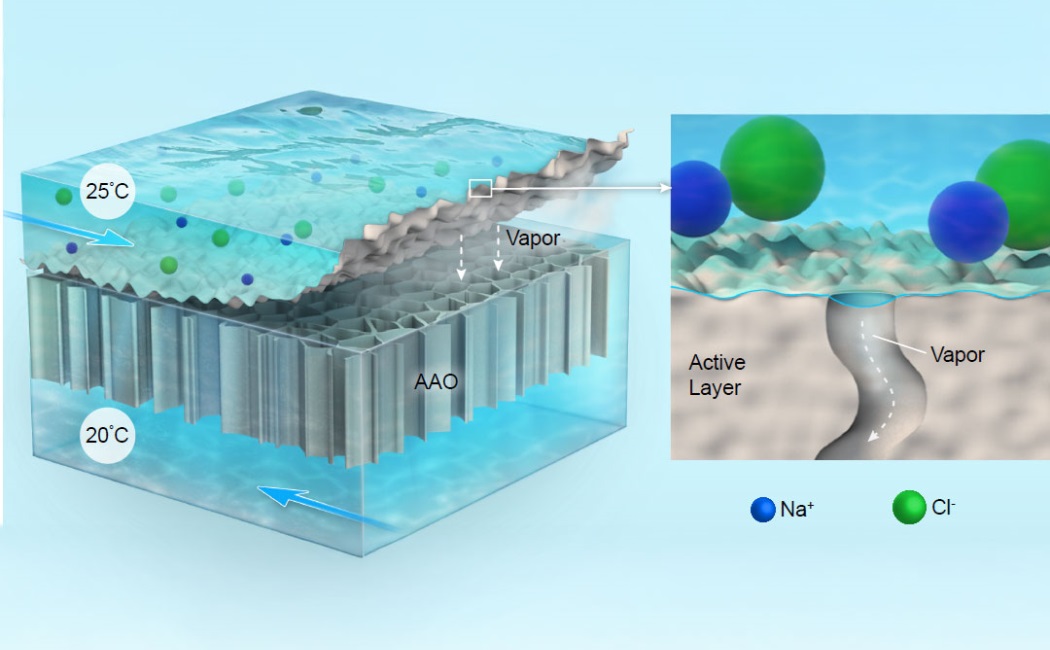
The study reports a significant advance in membrane-based desalination through the development of subnanoporous, superhydrophobic polymer membranes. These membranes enable efficient desalination of seawater and highly concentrated brines, achieving ultrahigh salt rejection with lower energy demand under mild operating conditions.
“This work shows that by engineering the membrane at the nanoscale, we can enable efficient desalination at ambient conditions,” said Dr. M. Obaid. “This opens the door to lower-energy water production, even for highly concentrated brines.”
Beyond a single material innovation, the findings point to broader technological implications for the field.
Researchers worldwide are intensively investigating next-generation desalination technologies,” explained Dr. Sofiane Soukane. “This progress may take integrated, novel thermal–membrane-based desalination concepts into a new era.”
From a strategic perspective, the work underscores the importance of translating fundamental science into deployable solutions.
“Water and energy are inseparable challenges for Saudi Arabia,” Professor Noreddine Ghaffour, lead author of the study and a specialist in desalination and water treatment at KAUST, said in KAUST News. “This work shows that it is possible to desalinate not only seawater, but even highly concentrated brines, using far less energy than traditional approaches. KAUST provides an environment where fundamental materials science can be translated into practical technologies that respond to real needs.”
Beyond performance metrics, the research highlights how fundamental materials science can be transformed into practical desalination technologies, with scalability, robustness, and real-world applicability at the core of the work. The study reflects close collaboration between the DESAL Research Group and a network of local and international partners.
Congratulations to all the authors — M. Obaid, Sofiane Soukane, Mohammed Rasool Qtaishat, Yaping Zhang, Vincent Guillerm, Hend Omar Mohamed, Maya Ayach, Venkatesh Singaravelu, Pedro Castaño, Guillaume Maurin, Mohamed Eddaoudi, Takeshi Matsuura, and Noreddine Ghaffour — on this collaborative achievement.
🔗 KAUST News: https://www.kaust.edu.sa/en/news/new-kaust-membrane-technology-could-make-desalination-more-sustainable
🔗 Nature Communications: https://www.nature.com/articles/s41467-025-68158-6
🔗 DESAL Research Group on LinkediIn: https://www.linkedin.com/company/desalatkaust
#DESAL #KAUST #NatureCommunications #Desalination #MembraneDistillation #MaterialsScience #WaterSustainability #AppliedInnovation