
22 November, 2026
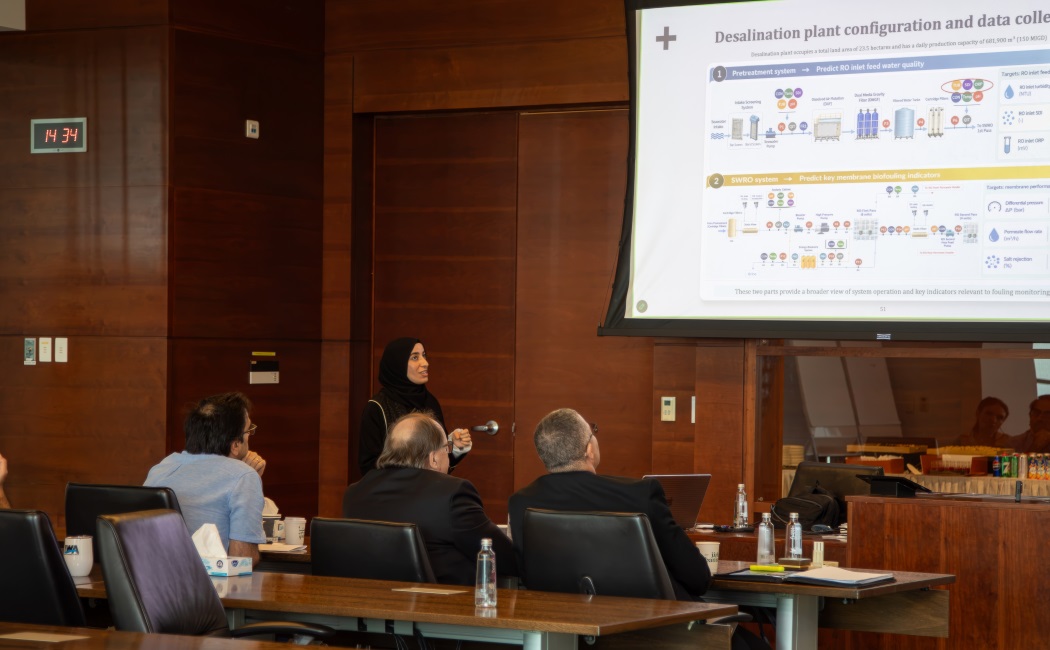
DESAL researcher Najat A.Amin successfully defended her PhD thesis at KAUST on 19 November 2026, completing all requirements for the PhD degree in the Environmental Science and Engineering (EnSE) program. Her research explores how artificial intelligence could help detect membrane biofouling earlier and support more informed decisions in seawater desalination.
Her dissertation, “AI-Driven Early Biofouling Detection in SWRO: From Advanced Lab-Scale Image-Based Concepts to Full-Scale Implementation”, was supervised by Professor Noreddine Ghaffour, who congratulated Dr. Najat and for her four years of hard work and dedication. The research brings together advanced imaging, experimental work and industrial operational data to address a challenge relevant to desalination in Saudi Arabia and worldwide.
We thank the defense committee, Professor Noreddine Ghaffour (supervisor), Professor Pascal Saikaly, Professor Ingo Pinnau and Professor Sangho Lee (external examiner), for their time, expertise and thoughtful discussion of Najat’s research.
Biofouling occurs when microorganisms accumulate and form biofilms on membrane surfaces. It can reduce membrane performance while increasing energy consumption, cleaning requirements and operating costs. Conventional operational indicators may reveal the problem after membrane performance has already been affected.
Najat investigated how AI could provide additional information about biofilm development and membrane performance. In the laboratory, she developed deep-learning models to estimate biofilm thickness from optical coherence tomography (OCT) images. She also explored whether membrane surface images could be used to detect fouling and predict biofilm thickness.
At pilot scale, she developed and tested an AI-based camera monitoring prototype, combining visual monitoring with conventional operational measurements to investigate the potential for earlier detection. A separate part of the research used full-scale seawater reverse osmosis (SWRO) plant data to estimate water-quality and membrane performance indicators relevant to fouling monitoring. Gradient-boosting approaches showed the strongest overall performance in that modelling work.
Together, these studies provide a foundation for integrated monitoring systems. Further validation will be needed to establish how the approaches perform over longer operating periods and under different plant conditions. The potential application is to give desalination teams earlier information to guide membrane operation and cleaning, with possible benefits for resource use, maintenance and membrane lifespan.
For Najat, connecting controlled experiments with industrial conditions was one of the most demanding parts of the PhD. It was also a source of motivation.
“The most rewarding part was developing an AI-based camera system for monitoring membrane fouling, which we successfully tested as a prototype at the pilot scale,” she said. “Seeing an idea developed during my PhD turn into a working technology with potential industrial applications was one of the most meaningful achievements of my research journey.”
Working with industrial data and collaborating with industry, including ACWA, helped shape her approach to research. Her PhD connected water treatment and experimental science with data analytics and AI, strengthening her interest in questions that are scientifically rigorous and relevant to practical water challenges.
As she explained, the experience shaped the questions she asks, including “How can it improve the way we understand and operate water treatment processes?”
Growing up in Saudi Arabia gave Najat an appreciation of water’s value and the importance of desalination to freshwater security. That experience continues to motivate her work on more efficient and sustainable water production.
“As a Saudi female researcher, I am also proud to be part of a generation of women contributing to science and innovation,” she said.
She sees opportunities for the next generation of researchers to develop solutions for Saudi Arabia and the wider world through the country’s growing investment in research and technology under Saudi Vision 2030.
Personally, the PhD also changed how she approaches challenges and opportunities, encouraging her to aim higher. At KAUST, a collaborative research environment, access to advanced facilities and opportunities to work with industry helped her strengthen her technical skills and develop confidence as an independent researcher.
Looking ahead, Najat hopes to continue developing AI-based solutions for water sustainability, strengthen collaboration between academia and industry, and mentor the next generation of researchers in Saudi Arabia.