DESAL RESEARCH GROUP

Sustainable technologies for a water-secure future

LEARN MORE
KEY VALUES

Committed to excellence

We aim to be at the forefront of global efforts to contribute to a water-secure future. We envision a world where sustainable desalination technologies and water treatment solutions are pivotal in providing clean and safe water to communities and fostering economic growth. Through continuous innovation and collaboration, we aspire to set new standards for excellence in the field, leaving a long-lasting effect on the well-being of societies and the health of our planet.
About

DESAL team at the lab
RESEARCH & TECHNOLOGY

Driven by innovation, recognized by impact

The DESAL Research Group pioneers advancements in desalination and wastewater treatment, prioritizing excellence, innovation, and sustainability. Our focus on cutting-edge research and efficiency aims to address global water challenges and support sustainable development goals.
NEWS & UPDATES 

Discover the latest breakthroughs from our team

15 February, 2026

DESAL summer intern Imran Alturkistani wins national awards at Ibdaa Science and Engineering Fair

Read more

02 February, 2026

New DESAL research published in Nature Communications advances energy-efficient desalination

Read more

28 January, 2026

DESAL and ACWA Power advance AI-based research for early membrane fouling detection

Read more
ADVANCING SCIENCE

Scientific Contributions

Through research papers, patents, and PhD dissertations, we push the boundaries of knowledge, driving innovation in desalination and water treatment.

Source separation of urine and treatment: Impact on energy consumption, greenhouse gas emissions, and decentralised wastewater treatment process

by Umakant Badeti, Jiaxi Jiang, Sanjay Kumarasingham, Abdulaziz Almuntashiri, Niren Kumar Pathak, Amit Chanan, Stefano Freguia, Wei Lun Ang, Ho Kyong Shon, Sherub Phuntsho
Year: 2024 DOI: https://doi.org/10.1016/j.desal.2024.117633

Abstract

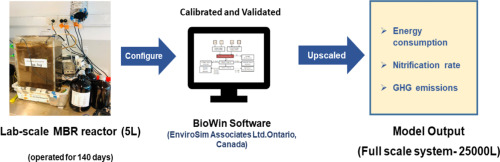
In this study, we calibrated the BioWin model to assess the energy consumption, greenhouse gas emissions, and volumetric nitrification rate in the treatment of high-ammonia-containing, source-separated urine within a decentralised wastewater treatment plant (WWTP) setting. Initially, we validated the model using lab-scale urine membrane bioreactor (MBR) treatment processes. Subsequently, the upscaled BioWin model was employed to evaluate the performance of a full-scale urine treatment system. Simulation results for urine treatment by MBR process, optimized at a dissolved oxygen set point of 3 mg/L, revealed an energy consumption of 3 kWh/kg N, greenhouse gas emissions of 25.6 kg CO2e/m3, and a volumetric nitrification rate of 310 mg N/L/d. Remarkably, this constitutes only 25–30 % of the total energy expended in the industrial-scale synthesis of a virgin fertiliser using the Haber-Bosch process. Our findings indicate that the collective energy demand of a urine diverted WWTP and a separate urine MBR for fertiliser recovery is comparable to that of a conventional MBR WWTP without nutrient recovery. Importantly, urine diversion reduces greenhouse gas emissions and the overall footprint of the WWTP compared to conventional ones. Moreover, nutrient recovery through urine source separation and treatment contributes significantly to nutrient recovery and circular economies.

Keywords

Source Separation of Urine Membrane Bioreactor Decentralised Wastewater Treatment Energy Consumption Nutrient Circular Economy

New Era Of Accelerated Impact

DISCOVER THE NEW KAUST STRATEGY
GET IN TOUCH

Collaborate with Us

Be part of our journey towards cleaner, safer water, reduced environmental impact, and economic growth. Whether you're a researcher, industry expert, or passionate advocate, let's collaborate to set new standards in desalination and wastewater treatment.